Course description
WHY MATERIALITY ASSESSMENT? WHY NOW?
In the current ESG and sustainability reporting environment, organisations are expected to demonstrate that their disclosures are supported by structured materiality assessments and meaningful stakeholder engagement. Regulators, investors, assurance providers, and other stakeholders now require companies to justify why certain ESG issues are considered material and how stakeholder views have been systematically considered.
ABOUT THE COURSE
This Certificate Course on Materiality Assessment and Stakeholder Engagement is designed to provide participants with a comprehensive understanding of how material issues are identified, evaluated, prioritised, and integrated into ESG strategy, reporting, governance, and risk management frameworks.
This course goes beyond theory and focuses on the practical processes used by organisations to conduct materiality assessments that meet regulatory expectations under Indian frameworks such as BRSR and BRSR Core, while also aligning with global standards including GRI, IFRS Sustainability Standards, and evolving assurance requirements. Participants will learn how to design stakeholder engagement processes, collect and analyse inputs, document outcomes, and apply materiality results across ESG reporting and business decision making.
MEET YOUR FACULTY
Dr. Tarini Mehta
GARP-SCR Certified Sustainability & Climate Risk Expert; Advocate & ESG Consultant, AA1000 Associate Certified Sustainability Assurance Practitioner
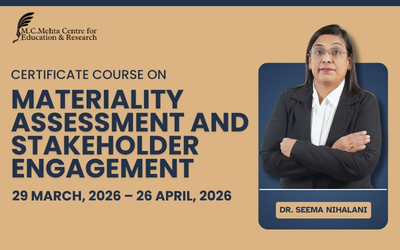
Dr. Seema Nihalani
Sustainability leader with over 21 years of experience in ESG Compliance, GHG Verification, Carbon Accounting, Life Cycle Assessment, Air and Water Quality Studies, and ISO Standards
HIGHLIGHTS OF THE PROGRAM
- Opportunity for networking with industry and sector leaders
- Real-world case studies
- Practical tools and templates
- Access to exclusive resources
- Comprehensive curriculum
WHAT YOU WILL LEARN?
By the end of this course, participants will be able to:
- Understand the concept of materiality in ESG and sustainability reporting and how it differs from traditional financial materiality.
- Explain the evolution of materiality from a compliance driven concept to a strategic decision-making tool.
- Distinguish between single materiality, double materiality, and impact materiality and apply them in different regulatory and business contexts.
- Identify and categorise internal and external stakeholders relevant to ESG performance and risk.
- Design structured stakeholder mapping and prioritisation frameworks.
- Develop and implement effective stakeholder engagement strategies using qualitative and quantitative methods.
- Collect, analyse, and validate stakeholder inputs for materiality determination.
- Identify ESG issues and themes using regulatory guidance, peer benchmarking, risk assessments, and internal data sources.
- Assess ESG impacts, risks, and opportunities using structured scoring and prioritisation tools.
- Develop materiality matrices and documentation suitable for internal approvals, board review, and assurance.
- Link material issues with ESG metrics, key performance indicators, and strategic objectives.
- Integrate materiality outcomes into BRSR and BRSR Core disclosures.
- Align materiality with enterprise risk management, business strategy, and governance frameworks.
- Ensure consistency, credibility, and audit readiness of ESG disclosures.